
There are many vampire legends in folklore, and the vampire myth continues to fascinate people around the world. Did you know that there are more types of vampires than the modern retelling of the vampire as a brooding, mysterious teenage boyfriend? The vampire and other paranormal blood-suckers in traditional vampire legends in folklore of different cultures worldwide are often more scary, vicious, and strange-looking than most of us could imagine.
Here are the top 5 vampire legends in traditional folklore that may surprise you:
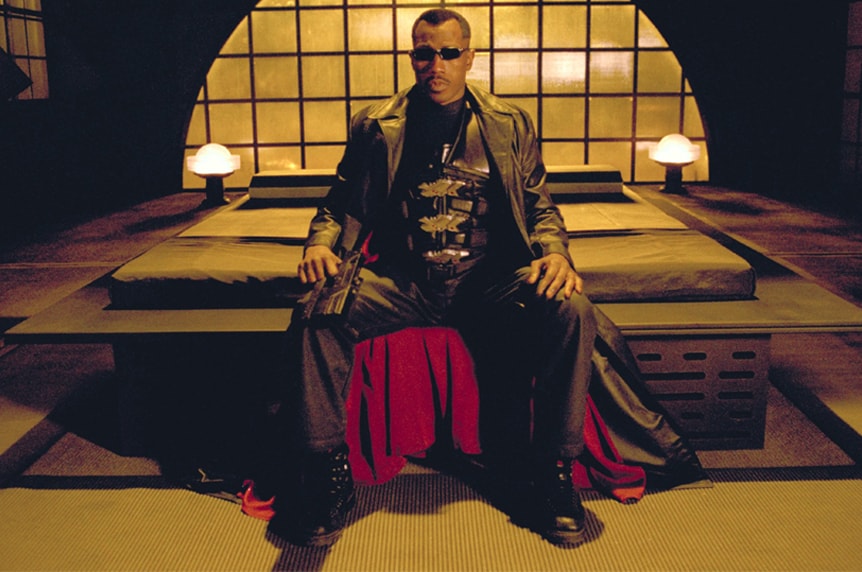
Source: New Line Cinema
According to Albanian folklore, a Dhampir or Daywalker is a half-vampire, half-human hybrid that is a result of a union between a vampire and a human. This union is typically between a male vampire and a female human, with the reverse being rare. In the Balkans, it is said that after their deaths, male vampires often sought out his wife or a woman he desired in life. Some legends describe Dhampirs as having disheveled dark or black hair, and missing a shadow. Other signs include a dirty look, having a prominent nose, having larger than normal ears, teeth, or eyes, having a soft body with deep marks, and no nails or bones.
Dhampirs have to consume blood, but the result of not feeding is less harsh than what happens to full vampires. They would not experience weakening to a significant extent, perhaps a loss of their abilities, but rarely death or severe dehydration like with vampires. They can survive on either blood or human food.
Dhampirs have a supernatural physical constitution. In terms of vampire powers, they typically possess the enhanced strength, speed, toughness, and perceptual abilities of vampires. They do not age, or if they do, only very slowly. Most Dhampirs will appear like ordinary humans, with many being exceptionally good-looking. Because of their hybrid nature, they may or may not experience the weaknesses and vampire traits of a full vampire, such as the inability to walk in daylight or come in contact with holy artifacts.
Blade from Marvel Comics is a Dhampir as a result of his mother's being bitten by a vampire while giving birth to him. His half-vampire nature makes him immune to certain traditional vampire weaknesses like silver, garlic, and sunlight. He is impervious to the bites of vampires and vampire mind control. He possesses supernatural speed, strength, toughness, and perception, as well as a rapid regeneration ability that allows him to recover from wounds overnight.
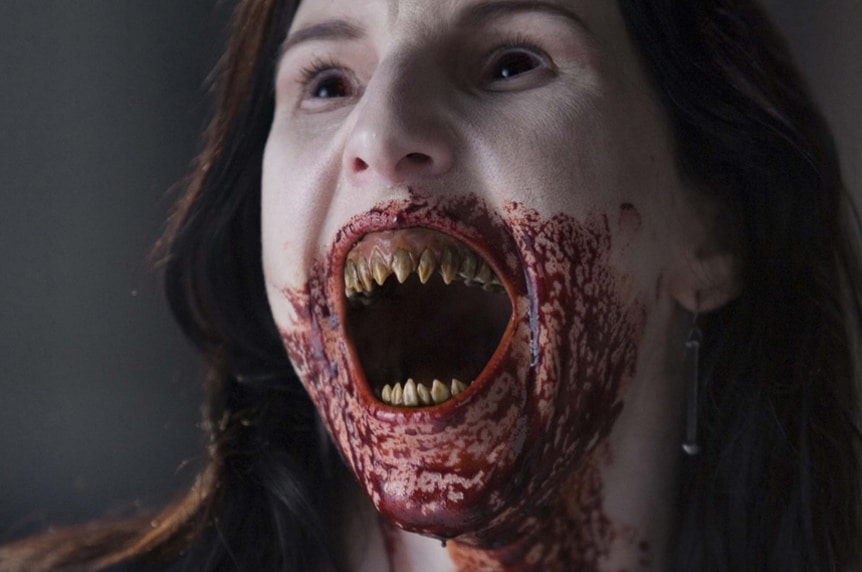
Source: Columbia Pictures
The Nelapsi is a walking dead, although no signs of decay are typically apparent. The Nelapsi has burning red eyes, pale skin, sharp claws, and pointy needle-like teeth. It may be wearing its burial shroud, or the clothing it was buried in. Often, the Nelapsi hunts its victims while naked. It is very strong and wild, with an insatiable appetite, and it will not stop stalking its targets until sunrise when it is forced to go back to its grave to sleep. The Nelapsi usually haunts graveyards in Slovakia and the surrounding Eastern European countries.
The Nelapsi feasts on the blood of humans and animals. It kills its victims by tearing them apart with its sharp teeth or crushing their bones. Any survivors of a Nelapsi attack are usually killed by the plague it brings. When angered, the Nelapsi will torture its victims for long periods of time before killing and devouring them. There are few vampires as malevolent as the Nelapsi. It is utterly vicious, and finds pleasure in destroying whole villages, leaving behind a trail of destruction and the bloodless bodies of humans and livestock.
It is believed that the Nelapsi is the dead body from a suicide, of a murderer, or a user of black magic, brought to life by a demon from Hell. It is a sadistic undead creature with a ravenous thirst for blood. The bond holding the flesh of the corpse and the malevolent spirit is so powerful that the Nelapsi is thought to be indestructible. It is believed to still exist to this day, coming out from its grave when night falls to seek out its prey.
The Nelapsi does not have the usual vampire weaknesses. It does not weaken to holy artifacts like the crucifix and holy water. Due to its supernatural toughness and strength, it is difficult to kill with weapons like guns or swords. When cornered, it is said to have the ability to kill with a terrifying glare. It has two hearts and two souls. Though the Nelapsi is not harmed under sunlight, it has to return to its grave by daybreak. Killing vampires like the Nelapsi is possible by destroying its heart or skull with a stake made of blackthorn (a relative of hawthorn), followed by severing its head, and then covering its body and stuffing its mouth with garlic before burying or burning its body. Garlic is believed to sever the bond between the malevolent spirit and the dead body. Like most vampires, the Nelapsi can also be distracted by sowing opium poppy on the grave, forcing it to count seeds all night until sunrise when it has to return to its grave without feeding.
To cleanse a village of the Nelapsi’s evil presence, a huge bonfire is usually lit, using only new wood. Effigies of evil are thrown into the fire, along with anything that had come into contact with the Nelapsi. Once the fire has burned down, the villagers and their livestock have to walk through the smoke and ashes to be purified. Each villager should then take some of the embers from the bonfire to place in their hearth-fires. Lastly, the ashes from the fire should be spread over the fields and along the roads as a final means of warding away evil.
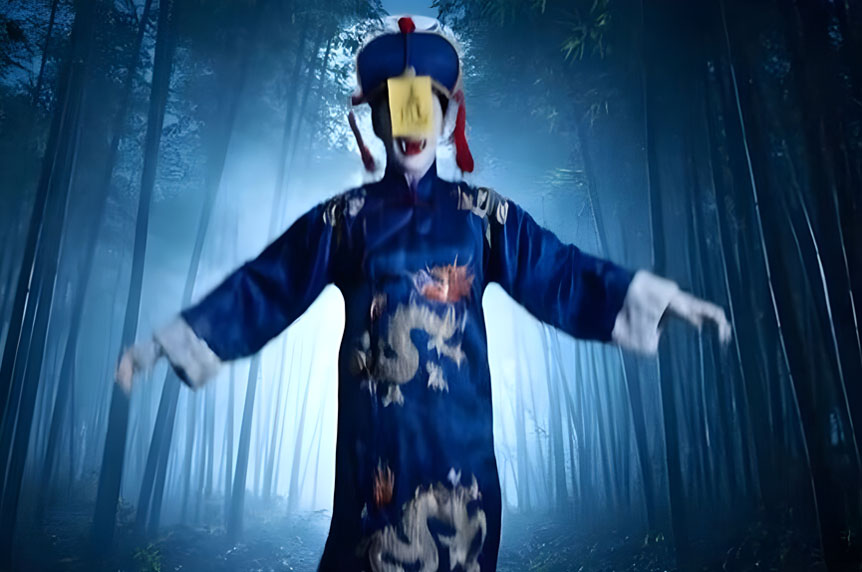
A Jiangshi, also called a Chinese ‘hopping’ vampire, is a type of undead creature found in Chinese folklore and myths. Jiangshis come about when a dead person’s soul fails to exit their body, typically due to an improper death, an act of suicide, a desire to haunt the living and cause mischief, or through the use of dark arts via necromancy. Jiangshi folktales have inspired a number of Jiangshi films and literature throughout East Asia.
Their appearance varies from the dead body of a recently deceased person, to a rotting corpse that has undergone a long period of decay. They have pale skin, long fingernails that are claw-like, and a long, flexible tongue. They may have greenish-white skin due to the presence of fungus or mold growing on the corpses. They is said to have long white hair all over their heads and may behave like wild animals. Jiangshis are normally depicted with paper talismans on their foreheads, which functions as a Taoist sealing spell, and dressed in the coat-like robe and round-top tall rimmed hat of a mandarin, also known as a Chinese official from the Qing dynasty.
The Chinese word for ‘jiang’ (僵) in ‘Jiangshi’ literally means ‘hard’ or ‘stiff’. It is believed that the Jiangshi is so stiff that it cannot bend its limbs and torso, so it has to travel by hopping around, with its arms stretched out for balance. During the day, they rest in coffins or hide in dark places such as caves.
Jiangshis are known to absorb life essence or ‘qi’ from living creatures for sustenance and to grow more powerful. However, due to modern Western vampire influences, some Jiangshis are acquired the blood-sucking characteristic. In some retellings, the Jiangshis find potential targets by sensing their breath. Holding one’s breath is said to temporarily hide one’s presence from a Jiangshi. It is said that if you suck out the unexpelled last breath from a Jiangshi, it will collapse into an inanimate corpse.
A source of Jiangshi stories come from the olden practice of transporting a corpse across many miles. When relatives are too poor to afford transportation of the deceased person’s body from far away to back home for burial, they would often hire a Taoist priest to conduct a ritual to reanimate the corpse and teach it to “hop” home. The priests would move the corpses only at night and would have bells they ring to let others know they are in the presence of a Jiangshi and to avoid the place because it is believed to be bad luck for a living person to set eyes upon a Jiangshi. To protect themselves, the priests would adorn a headdress with a veil covering their faces. This is so that the Jiangshis they were transporting would move beside them without being tempted to devour the priest. Taoist talisman, stuck on the forehead of the Jiangshi, would also immobilize them until it is removed.
In other traditions, dead bodies to be transported would be placed upright in a single file and tied to long bamboo rods on the sides, while two men (one at the front and one at the back) would shoulder the ends of the rods as they moved. When the bamboo bounced up and down, the dead bodies would seem to be ‘hopping’ when viewed from far away.
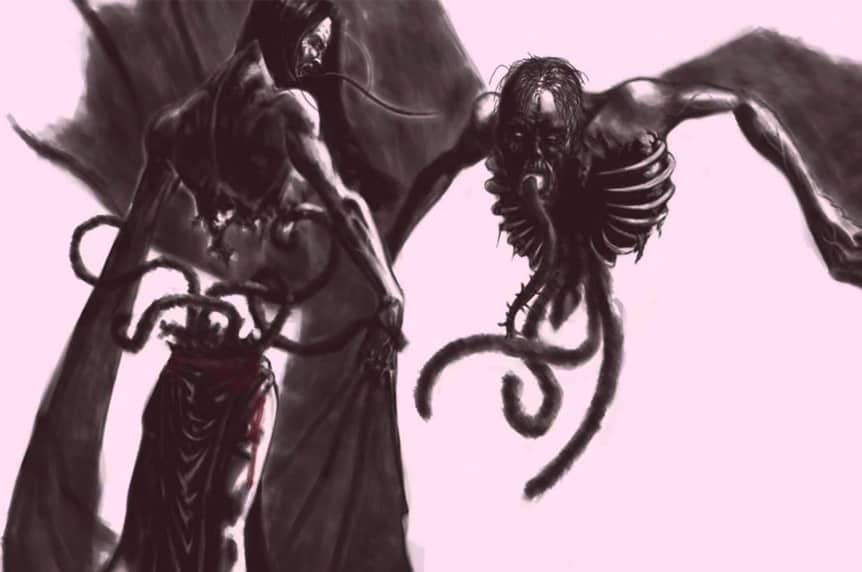
The Manananggal is a mythical vampire-like creature of the Philippines. It is an evil, man-eating, blood-sucking witch or monster. In terms of appearance, it is often described as horrifying, scary, female, and capable of separating its upper torso and spawning large bat-like wings that allow it to fly in search of victims at night. Folklores of the Manananggal are commonly heard in the Visayan region of the Philippines, especially in the western provinces of Capiz, Iloilo, and Antique, as with the tales of other kinds of paranormal creatures, such as ghosts, goblins, ghouls generally referred to as aswangs. Sightings are reported, and local residents believe in their existence despite modernization. Stories of similar creatures can be found in neighboring Indonesia and Malaysia.
The word ‘Manananggal’ comes from the Tagalog word tanggal, which means ‘to remove’ or ‘to separate’. The Manananggal literally translates to ‘one who separates itself’. It also originates from an expression used for a severed torso.
The Manananggal typically targets pregnant women who are sleeping, using their long, trunk-like tongue to feed on the hearts of unborn babies, or the blood of a slumbering person. The severed lower torso of the Manananggal is left behind while the upper torso flies. Hence, the lower torso is said to be the weak point of the two halves. Putting salt, crushed garlic or ash on the lower torso is one of the ways to kill the Manananggal. The upper torso would not be able to rejoin itself with the lower half and thus the Manananggal will die by daybreak.
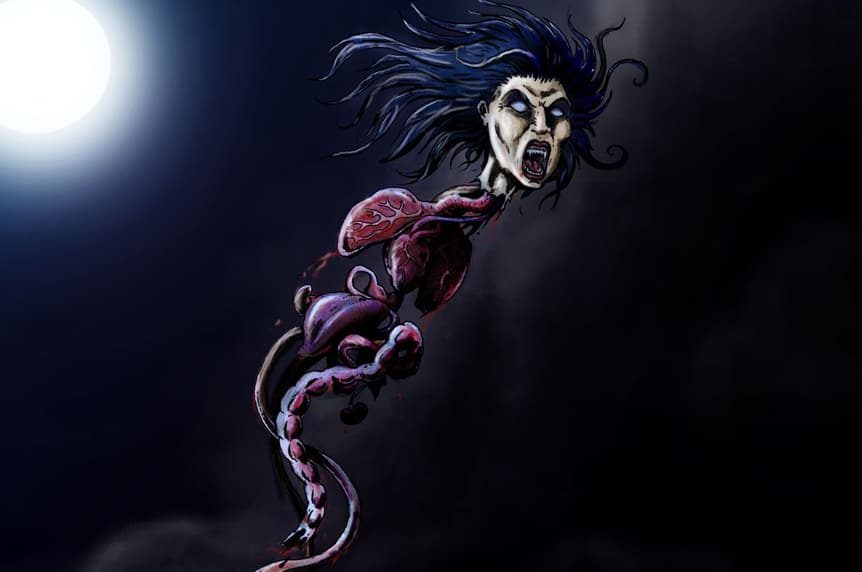
The Penanggalan or 'Hantu Penanggal' is a paranormal creature of Malaysian folklore. It is similar to the Manananggal of Filipino folklore. The word ‘Penanggal’ literally translates to "detach" or "remove". According to legend, a Penanggalan is a living human being during daytime, but is able to detach its head from its body and fly through the use of black magic. As it travels, its stomach and entrails are said to hang below it, sparkling like fireflies as the Penanggalan flies at night. It is often said to be an attractive woman, either young or old, who obtained her good looks through black magic, or from a pact with the devil to obtain supernatural abilities.
After a night of feasting on blood, the Penanggalan will return home and immerse her organs in a vat of vinegar in order to shrink them down before she reattaches to her body. The Penanggalan is followed by the smell of vinegar wherever she flies at night and during daytime when she poses as an ordinary woman. The odor is how the Penanggalan is identified and exposed.
The Penanggalan's victims are traditionally pregnant women and young children. Like a banshee who appears at a birth rather than a death, the Penanggalan perches on the roofs of houses where women are in labor, screeching when the child is born. The Penanggalan will insert a long invisible tongue into the house to lap up the blood of the new mother. Those whose blood the Penanggalan feeds upon contract a wasting disease that is almost inescapably fatal. Furthermore, even if the Penanggalan is not successful in her attempt to feed, anyone who is brushed by the dripping entrails will suffer painful open sores that won't heal without a bomoh's help.
The Penanggalan typically prefers the blood of a newborn baby, young children, or a woman who had recently given birth. Some claim that the Penanggalan can extend a long invisible tongue into a house to lap up the blood of a woman giving birth. The victim is said to contract a wasting disease that is typically fatal. Others say that a Penanggalan can pass through walls, or even ooze up through the cracks in the floorboards of a house, going into the room where a baby or pregnant woman sleeps.
The most popular method of defending against a Penanggalan attack is to spread around the thorny leaves of a local plant known as mengkuang, which would either injure or trap the exposed lungs, stomach and intestines of the Penanggalan as it hunts for its victims. These thorns can be wound around the windows of a house in order to trap the hanging entrails. This is typically done when a woman has just given birth. It is said that months before birth, family members of pregnant women would plant pineapples. The prickly flesh and leaves of the pineapple fruit would prevent the Penanggalan from attacking. The pregnant woman can also store scissors or betel nut cutters under her pillow to protect from the Penanggalan.
The Penanggalan may be killed by pouring shards of broken glass into the empty neck cavity of the detached torso, which will destroy the organs of the Penanggalan when it reattaches to the body. It is also possible to consecrate the body and burn it or somehow keeping it away from the Penanggalan before daybreak.
Do you know of any other vampire legends in folklore? Share them below!